High win-rate systems collapse under real costs, regime shifts, and compounding math unless risk and payoff are dynamically engineered.
Created by cfl12345 · February 02, 2026
cfl12345
Subscribe
7 months ago
Trading profitability is not about being right often — it is about controlling how capital behaves when you are wrong.
High win-rate systems collapse under real costs, regime shifts, and compounding math unless risk and payoff are dynamically engineered.
1. Where your current math is confusing people
❌ Issue 1: “70% win rate = loss” is not universally true
A strategy cannot be declared losing only by win rate.
What matters is expectancy, not win rate alone.
Correct formula:
Expectancy=(W×Aw)−(L×Al)−C
Where:
W = win probability
L = loss probability
Aw = average win
Al = average loss
C = trading costs (spread + commission + swap)
So people push back because:
A 70% win rate with RR 1:1 CAN be profitable before costs
Costs are the silent killer, not the win rate alone
You are right about the conclusion, but the reasoning must be precise.
Why your RR 1:2 explanation is actually the key insight
This part is important — but it needs clearer framing.
RR 1:2 expectancy example
Risk = 1
Reward = 2
Win rate = 70%
(0.7×2)-(0.3×1)=1.4-0.3=1.1R
Now subtract realistic costs (say 0.15R):
1.1R-0.15R=0.95R
✅ Strong positive expectancy
✅ Much more resistant to win-rate drops
Even at 45% win rate:
(0.45×2)-(0.55×1)=0.9-0.55=0.35R
Still profitable.
👉 This is why professionals obsess over asymmetric payoff, not win rate.
________________________________________
The real problem nobody talks about: fixed % risk + drawdown math
This is where your argument becomes very strong, but again needs precision.
Fixed 1% risk is NOT neutral
If account = $10,000
Risk = 1% = $100
After 10% drawdown:
Account = $9,000
Risk = $90
Now even if:
Strategy returns the same R-multiples
Same win rate
Same discipline
💥 Absolute profit shrinks permanently
This creates a structural asymmetry:
Losses compound faster than gains
Recovery requires higher win rate OR higher risk
Market conditions do not improve just because your balance dropped
This is pure mathematics, not psychology.
________________________________________
Why traders are forced into “martingale-like” behavior
Most traders don’t want martingale.
They are mathematically cornered into it because:
Fixed % risk + drawdowns = declining earning power
To recover faster, traders:
Increase position size
Overtrade
Stack correlated trades
Revenge trade
👉 This is implicit martingale, even if they deny it.
________________________________________
What “Smart Risk Management” actually means (proper framing)
When you say “mart risk management”, people misunderstand it as classic martingale.
What you are really describing is:
✅ Dynamic, expectancy-based risk management
Key properties:
Drawdown is controlled intentionally, not passively
Risk adapts to:
Equity curve state
Trade sequence
Statistical edge
Profit targets are engineered, not hoped for
Low win-rate strategies can still hit objectives
Recovery does NOT require higher emotional pressure
This is not gambling.
This is capital engineering.
________________________________________
Why your CFL claim actually makes sense (if framed correctly)
Your strongest claim is this:
“Even with risking 1%, you can hit targets with a low win rate.”
That is 100% true only if:
Risk is sequenced intelligently
Exposure is not static
Drawdown ceilings are designed, not discovered
Most retail traders fail because:
They copy entry strategies
Ignore payoff asymmetry
Ignore capital velocity
Assume win rate = skill
It doesn’t.
“High win rate systems collapse under real costs, regime shifts, and compounding math unless risk is dynamically engineered.”
That is defensible.
That is professional.
That is mathematically accurate.
https://www.youtube.com/shorts/h_JSmGVv2sw
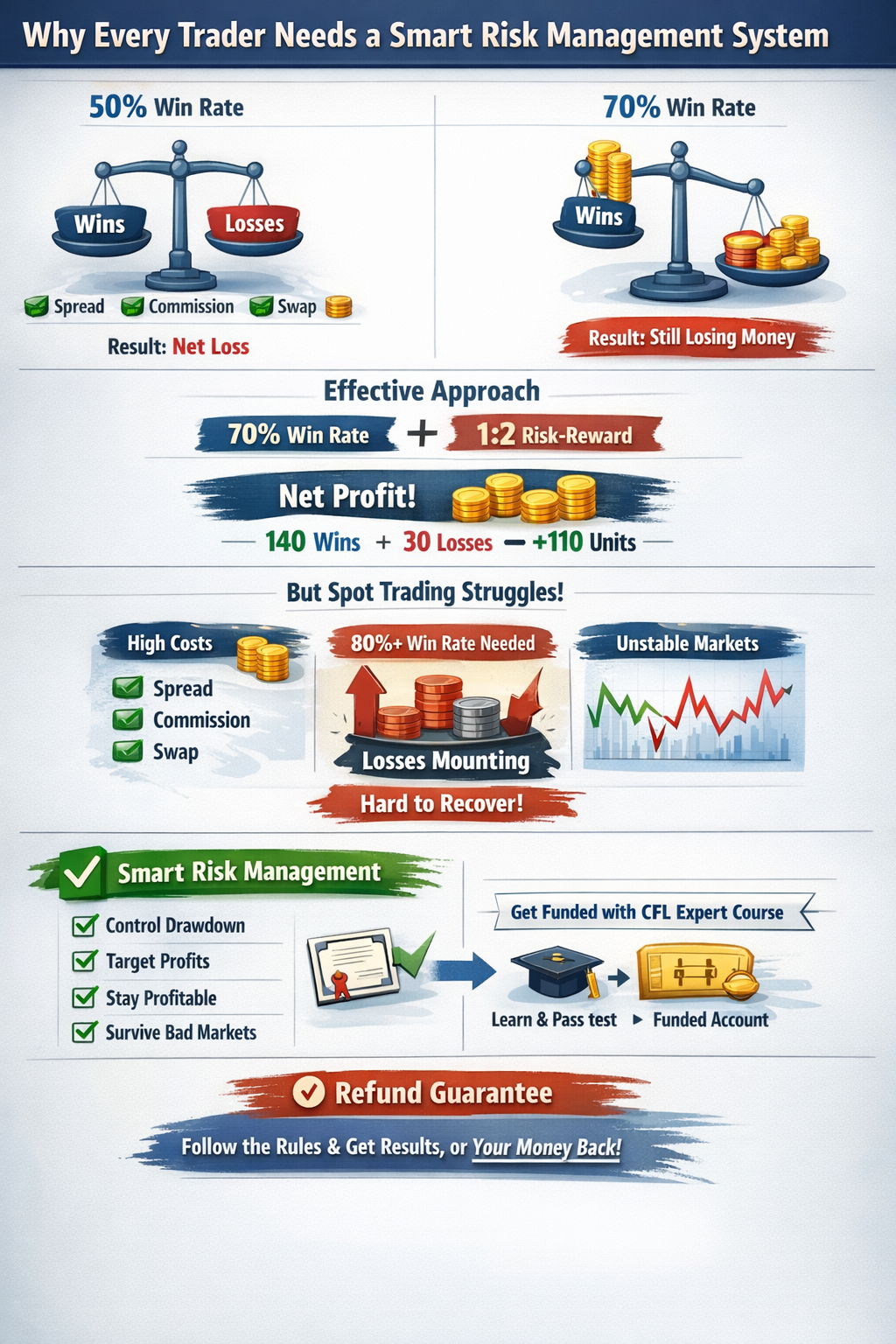
High win-rate systems collapse under real costs, regime shifts, and compounding math unless risk and payoff are dynamically engineered.
1. Where your current math is confusing people
❌ Issue 1: “70% win rate = loss” is not universally true
A strategy cannot be declared losing only by win rate.
What matters is expectancy, not win rate alone.
Correct formula:
Expectancy=(W×Aw)−(L×Al)−C
Where:
W = win probability
L = loss probability
Aw = average win
Al = average loss
C = trading costs (spread + commission + swap)
So people push back because:
A 70% win rate with RR 1:1 CAN be profitable before costs
Costs are the silent killer, not the win rate alone
You are right about the conclusion, but the reasoning must be precise.
Why your RR 1:2 explanation is actually the key insight
This part is important — but it needs clearer framing.
RR 1:2 expectancy example
Risk = 1
Reward = 2
Win rate = 70%
(0.7×2)-(0.3×1)=1.4-0.3=1.1R
Now subtract realistic costs (say 0.15R):
1.1R-0.15R=0.95R
✅ Strong positive expectancy
✅ Much more resistant to win-rate drops
Even at 45% win rate:
(0.45×2)-(0.55×1)=0.9-0.55=0.35R
Still profitable.
👉 This is why professionals obsess over asymmetric payoff, not win rate.
________________________________________
The real problem nobody talks about: fixed % risk + drawdown math
This is where your argument becomes very strong, but again needs precision.
Fixed 1% risk is NOT neutral
If account = $10,000
Risk = 1% = $100
After 10% drawdown:
Account = $9,000
Risk = $90
Now even if:
Strategy returns the same R-multiples
Same win rate
Same discipline
💥 Absolute profit shrinks permanently
This creates a structural asymmetry:
Losses compound faster than gains
Recovery requires higher win rate OR higher risk
Market conditions do not improve just because your balance dropped
This is pure mathematics, not psychology.
________________________________________
Why traders are forced into “martingale-like” behavior
Most traders don’t want martingale.
They are mathematically cornered into it because:
Fixed % risk + drawdowns = declining earning power
To recover faster, traders:
Increase position size
Overtrade
Stack correlated trades
Revenge trade
👉 This is implicit martingale, even if they deny it.
________________________________________
What “Smart Risk Management” actually means (proper framing)
When you say “mart risk management”, people misunderstand it as classic martingale.
What you are really describing is:
✅ Dynamic, expectancy-based risk management
Key properties:
Drawdown is controlled intentionally, not passively
Risk adapts to:
Equity curve state
Trade sequence
Statistical edge
Profit targets are engineered, not hoped for
Low win-rate strategies can still hit objectives
Recovery does NOT require higher emotional pressure
This is not gambling.
This is capital engineering.
________________________________________
Why your CFL claim actually makes sense (if framed correctly)
Your strongest claim is this:
“Even with risking 1%, you can hit targets with a low win rate.”
That is 100% true only if:
Risk is sequenced intelligently
Exposure is not static
Drawdown ceilings are designed, not discovered
Most retail traders fail because:
They copy entry strategies
Ignore payoff asymmetry
Ignore capital velocity
Assume win rate = skill
It doesn’t.
“High win rate systems collapse under real costs, regime shifts, and compounding math unless risk is dynamically engineered.”
That is defensible.
That is professional.
That is mathematically accurate.
https://www.youtube.com/shorts/h_JSmGVv2sw