🧵 Risk Management Made Simple – Step-by-Step with Examples
Created by cfl12345 · February 02, 2026
cfl12345
Subscribe
8 months ago
🧵 Risk Management Made Simple – Step-by-Step with Examples
Risk management isn’t optional in trading—it’s the difference between surviving and blowing your account. Let’s break it down with real examples.
Define your risk per trade
Rule of thumb: 1–2% of your account balance.
Example: Account = $10,000
Risk per trade = 1% → $100 max loss per trade
Determine stop-loss
Decide where your trade will be wrong. Stop-loss protects your capital.
Example: Buying XYZ at $50, you set stop-loss at $48 → $2 risk per share
Calculate position size
Position size = Risk per trade ÷ (Entry price − Stop-loss)
Example: $100 ÷ $2 = 50 shares
Check risk/reward ratio
Good trades target reward > risk. A 2:1 ratio is a solid starting point.
Example: Risk $100 → Target profit = $200
Diversify
Never put all capital in one trade. Spread risk across assets or strategies.
Keep a trading journal
Track every trade: entry, exit, risk, outcome. It teaches discipline.
Prepare for drawdowns
Know your max tolerable drawdown (e.g., 10–15%). Stop trading if exceeded.
Emotional control matters
Fear & greed ruin positions. Stick to your pre-defined stops and targets.
Contingency plan
Markets can gap or crash. Always plan exits for unexpected events.
Quick Example – Forex Micro Lot
Account: $5,000
Risk per trade: 2% = $100
EUR/USD entry: 1.1000, stop-loss 1.0980 → 20 pips risk
Position size = $100 ÷ 20 pips = 0.5 mini lots (~5,000 units)
If price hits stop-loss, you lose $100.
If trade reaches 40 pips profit → $200 gain → 2:1 reward/risk
Example – Stock Trade
Account: $20,000
Risk per trade: 1% = $200
Buy ABC at $100, stop-loss $95 → $5 risk/share
Position size = $200 ÷ $5 = 40 shares
If stock hits $110 → profit = 40 × $10 = $400 → reward/risk = 2:1
Key Point: Small losses + big winners = account growth.
Avoid “all-in” trades
Even with a perfect setup, one mistake can wipe your account.
Adjust risk based on confidence
High-probability trades = 1–2%, lower probability → less than 1%.
Daily stop-loss cap
Set a maximum daily loss limit, e.g., 3% of your account. Stop trading if hit.
Weekly / monthly review
Check which trades followed rules, which didn’t, and adjust risk strategy accordingly.
Risk management formula cheat sheet:
Risk per trade = Account × % risk
Position size = Risk per trade ÷ (Entry − Stop-loss)
Reward/risk ≥ 2:1
Max daily loss = Account × % daily limit
Remember: Survival first, profits second. Protect your capital, and profits will follow.
Trading without risk management is gambling. With it, you’re making calculated decisions.
Even the best strategy fails if risk isn’t managed. Risk management is the backbone of every winning trader.
💡 Tip: Create a simple spreadsheet for position size & risk calculations. It saves mistakes and stress.
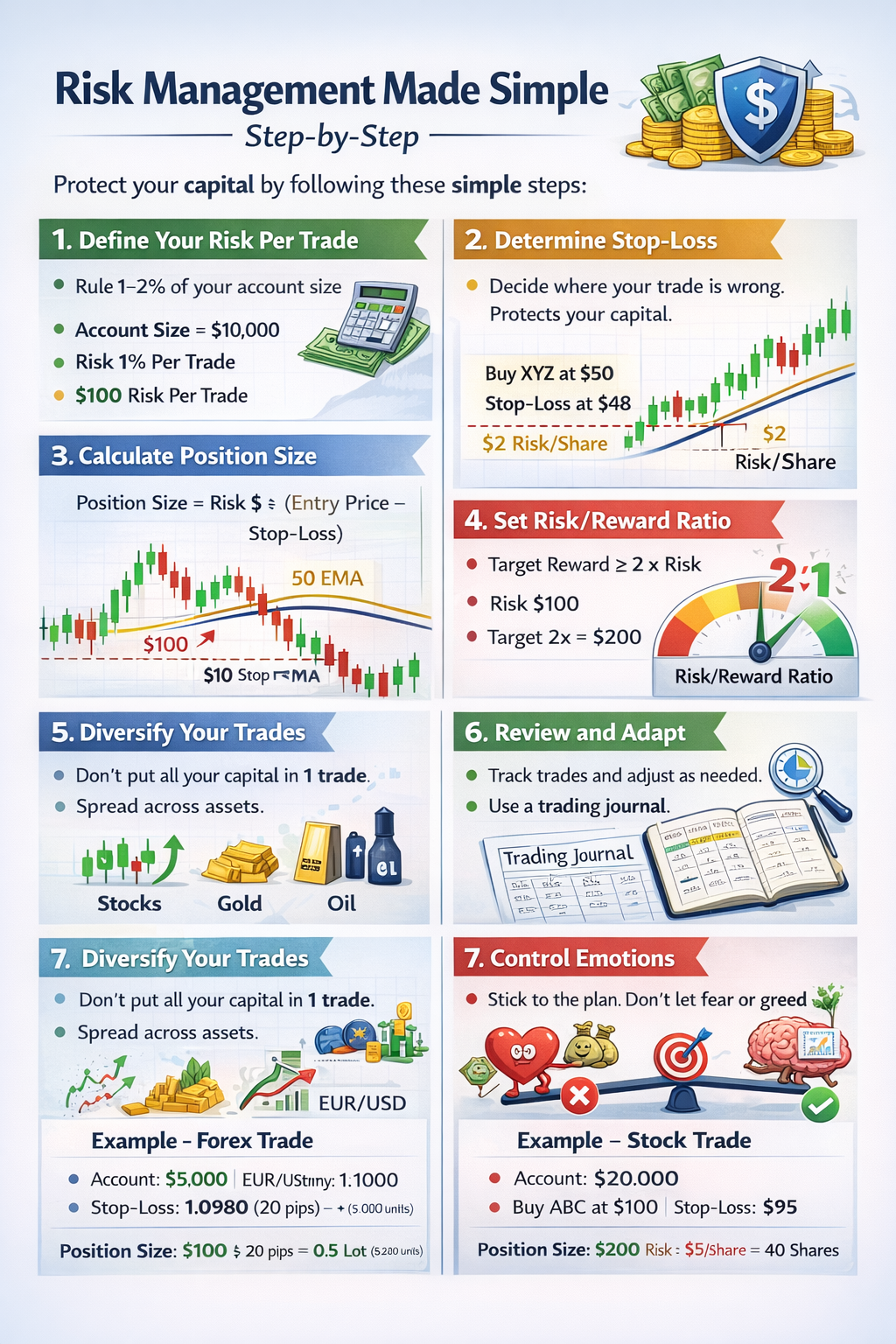
Risk management isn’t optional in trading—it’s the difference between surviving and blowing your account. Let’s break it down with real examples.
Define your risk per trade
Rule of thumb: 1–2% of your account balance.
Example: Account = $10,000
Risk per trade = 1% → $100 max loss per trade
Determine stop-loss
Decide where your trade will be wrong. Stop-loss protects your capital.
Example: Buying XYZ at $50, you set stop-loss at $48 → $2 risk per share
Calculate position size
Position size = Risk per trade ÷ (Entry price − Stop-loss)
Example: $100 ÷ $2 = 50 shares
Check risk/reward ratio
Good trades target reward > risk. A 2:1 ratio is a solid starting point.
Example: Risk $100 → Target profit = $200
Diversify
Never put all capital in one trade. Spread risk across assets or strategies.
Keep a trading journal
Track every trade: entry, exit, risk, outcome. It teaches discipline.
Prepare for drawdowns
Know your max tolerable drawdown (e.g., 10–15%). Stop trading if exceeded.
Emotional control matters
Fear & greed ruin positions. Stick to your pre-defined stops and targets.
Contingency plan
Markets can gap or crash. Always plan exits for unexpected events.
Quick Example – Forex Micro Lot
Account: $5,000
Risk per trade: 2% = $100
EUR/USD entry: 1.1000, stop-loss 1.0980 → 20 pips risk
Position size = $100 ÷ 20 pips = 0.5 mini lots (~5,000 units)
If price hits stop-loss, you lose $100.
If trade reaches 40 pips profit → $200 gain → 2:1 reward/risk
Example – Stock Trade
Account: $20,000
Risk per trade: 1% = $200
Buy ABC at $100, stop-loss $95 → $5 risk/share
Position size = $200 ÷ $5 = 40 shares
If stock hits $110 → profit = 40 × $10 = $400 → reward/risk = 2:1
Key Point: Small losses + big winners = account growth.
Avoid “all-in” trades
Even with a perfect setup, one mistake can wipe your account.
Adjust risk based on confidence
High-probability trades = 1–2%, lower probability → less than 1%.
Daily stop-loss cap
Set a maximum daily loss limit, e.g., 3% of your account. Stop trading if hit.
Weekly / monthly review
Check which trades followed rules, which didn’t, and adjust risk strategy accordingly.
Risk management formula cheat sheet:
Risk per trade = Account × % risk
Position size = Risk per trade ÷ (Entry − Stop-loss)
Reward/risk ≥ 2:1
Max daily loss = Account × % daily limit
Remember: Survival first, profits second. Protect your capital, and profits will follow.
Trading without risk management is gambling. With it, you’re making calculated decisions.
Even the best strategy fails if risk isn’t managed. Risk management is the backbone of every winning trader.
💡 Tip: Create a simple spreadsheet for position size & risk calculations. It saves mistakes and stress.